
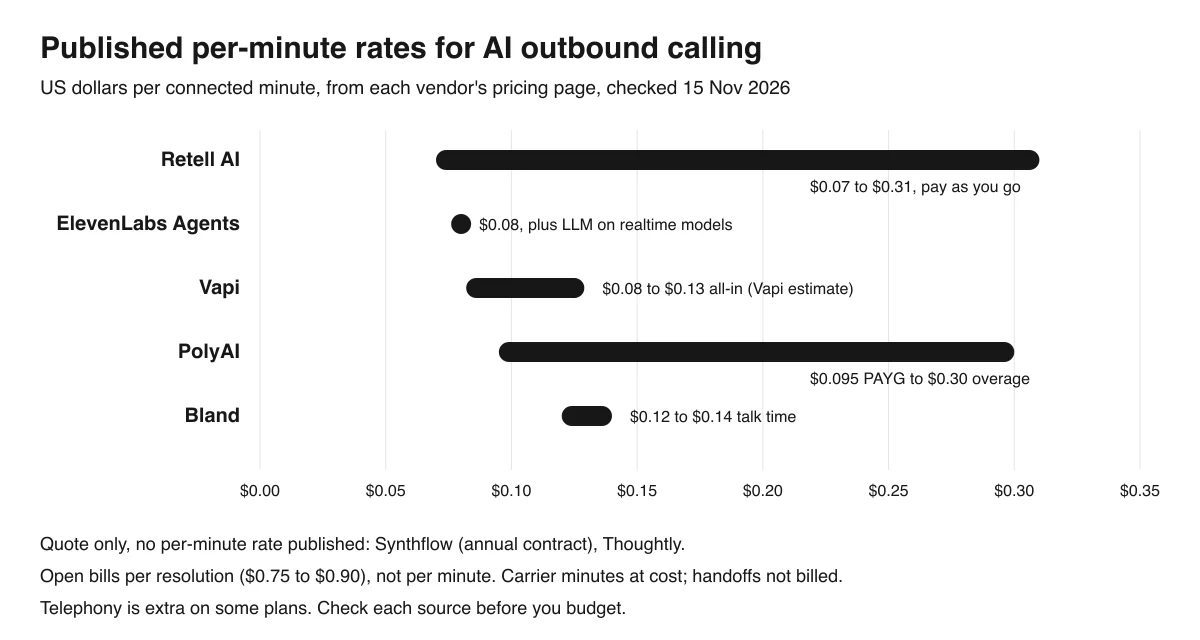
The best AI outbound calling software depends on who will build and run the agent. If you have engineers, developer platforms like Retell AI, Vapi and Bland publish the lowest rates, roughly $0.07 to $0.31 per connected minute. If you want the vendor to scope and launch it, Synthflow, Thoughtly and PolyAI sell managed plans, and if outbound is part of customer support, Open runs it with the same agent that answers inbound, billed per resolution.
Below, we compare eight platforms on the five things that decide an outbound project: consent controls, voice quality, CRM and carrier fit, languages, and how you're billed. Every price links to its source and was checked on 15 November 2026.
TL;DR
- Lowest published per-minute rates: Retell AI ($0.07 to $0.31), ElevenLabs Agents ($0.08 plus LLM on realtime models), Vapi (about $0.08 to $0.13 all-in, by Vapi's own estimate), Bland ($0.12 to $0.14 talk time).
- Quote only: Synthflow now sells annual enterprise agreements with no per-minute rate. Thoughtly lists plans but no prices.
- Inbound-first vendors: PolyAI publishes plans from $49 a month, but outbound has to be switched on by its team.
- Billed per outcome instead of per minute: Open, at $0.75 to $0.90 per resolution, with carrier minutes at cost and handoffs not billed.
- Consent is your job, not the vendor's. Since February 2024, US law treats AI voices like prerecorded calls. Pick software that enforces do-not-call lists, calling windows and opt-outs, but collect the consent yourself.
AI outbound calling software compared (checked 15 November 2026)
| Platform | Best for | Pricing model | Published price | Outbound controls on the vendor's site |
|---|---|---|---|---|
| Retell AI | Developer teams running high-volume campaigns | Per minute, pay as you go | $0.07 to $0.31 per minute. Batch calls +$0.005 per dial. 20 concurrent calls included | Batch campaigns, calling windows, DNC screening, auto opt-out, retries, branded caller ID |
| Vapi | Developers who want to pick every model | Per minute hosting plus pass-through model costs | $0.05 per minute hosting. Vapi estimates $82 to $129 for 1,000 minutes all-in | API-first. You build campaign logic and compliance checks |
| Bland | Large enterprises that want self-hosting | Per minute plus optional platform fee | Start: $0.14 per minute. Build: $299 a month and $0.12 per minute. Telephony extra | Inbound and outbound in 40+ languages. Self-host or on-premises option |
| ElevenLabs Agents | Teams that care most about voice quality | Per minute, inside an ElevenLabs plan | $0.08 per minute, $0.16 above your concurrency limit. LLM tokens extra on realtime models | Batch calling through Twilio or SIP trunk numbers, scheduled or immediate |
| Synthflow | Mid-market and enterprise teams that want a launch team | Annual enterprise agreement | Quote only. No free plan, trial or per-minute rate | CRM, calendar and contact-center connections. Forward-deployed engineers |
| Thoughtly | Sales and marketing teams that live in HubSpot, Salesforce or Zoho | Plan-based, unlimited voice minutes | Quote only | Inbound and outbound on all plans, two-way CRM sync |
| PolyAI | Enterprises whose main need is inbound | Subscription with included minutes, or pay as you go | $49 a month (250 minutes), $199 (1,000), $299 per location (1,500). Overage $0.20 to $0.30 per minute | Outbound via API or SIP, enabled by PolyAI on request |
| Open | Support teams that want one agent for inbound and outbound | Per resolution | $0.75 to $0.90 per resolution. Carrier minutes at cost. Handoffs not billed | Configurable disclosures, DNC lists, time-of-day windows, opt-out detection, consent capture, voicemail detection |
Prices change often, and several vendors bill telephony, premium voices or add-ons on top. Read each source before you budget.
How to choose AI outbound calling software
Most "best of" lists rank tools on features. For outbound, five questions do more work.
1. Does it enforce consent and calling rules?
In February 2024 the FCC confirmed that the TCPA's rules on "artificial or prerecorded voice" cover AI-generated voices. In practice, an AI outbound call to a US consumer needs prior consent (written consent for marketing), must identify the caller and must offer an opt-out. The UK and EU layer PECR, GDPR and AI Act transparency duties on top. We cover the rules country by country in Is AI outbound calling legal?.
No software can create consent you don't have. What it can do is stop calls that break your rules. Look for:
- Do-not-call screening before every dial, and automatic DNC updates when someone opts out on a call
- Calling windows by time zone or region
- A configurable disclosure at the start of the call
- Consent and opt-out records you can export for an audit
Ask how a vendor handles each one. "TCPA-ready" on a landing page tells you little.
2. How does it sound, and how fast does it reply?
Outbound calls have less goodwill than inbound ones. The person didn't ask to talk to you, so a two-second pause or a robotic voice ends the call. Vendors publish latency in different ways: Retell quotes about 600 ms response time, and Open quotes reply latency under 200 ms. Because the measurements aren't defined the same way, place test calls on a real phone line, from the region you'll call, before you compare.
3. Will it fit your carrier and CRM?
Outbound only pays off when the outcome lands somewhere useful. Check three things:
- Carrier. Can you bring your own numbers and SIP trunk, or must you buy numbers from the vendor? Retell, Vapi, Bland, ElevenLabs and Open all support your own telephony in some form.
- Triggers. Can a CRM event (a failed payment, a new lead) start a call through an API or webhook, or only a CSV upload?
- Write-back. Does the call outcome, transcript and recording go back into the CRM or helpdesk record automatically?
If your team works in a power dialer today, read our AI dialer guide first. A dialer that helps human reps is a different purchase from an agent that holds the call itself.
4. Does it speak your customers' languages, including Arabic?
Language counts on vendor pages range from about 17 to over 100, and they rarely say which dialects. Bland lists 40+ languages. Retell says supported languages depend on the speech and voice provider you pick. Open lists Arabic among 100+ languages and picks the language per call from the CRM record or detection.
For the Gulf, ask for test calls in Saudi or Emirati Arabic, not Modern Standard Arabic, and check how the agent handles a customer who switches to English halfway through a sentence.
5. What are you actually paying for?
Per-minute pricing bills every connected minute, whether the call ends in a booking, a voicemail or a hang-up. Per-resolution pricing bills only when the call achieves its goal. Neither is always cheaper:
- Per minute wins when calls are short and most of them succeed, for example a 40-second delivery confirmation.
- Per resolution wins when many calls fail, run long or end with a handoff, for example collections or win-back.
An illustration, not a quote: a 3-minute call costs $0.21 to $0.93 on Retell's published pay-as-you-go range and $0.36 to $0.42 in Bland talk time, before telephony. On Open the same call costs $0.75 to $0.90 if it resolves the customer's request and nothing if it doesn't or is handed to a person. Run your own call length and success rate through both, and see our breakdown of AI phone agent costs for the full cost stack.
The platforms in detail
Retell AI
Retell is a developer platform with strong outbound tooling built in. Its Batch Call feature picks who to call and when, inside calling windows you set, with do-not-call screening, local area code matching, retries and automatic DNC updates on opt-out. Pay-as-you-go voice costs $0.07 to $0.31 per minute depending on the model and voice you choose, with $10 in free credit. Twenty concurrent calls are included, and each extra line costs $8 a month. Watch the add-ons: branded caller ID is $0.10 per outbound call.
Choose it if you have engineers and want the lowest published rate with campaign controls already built.
Vapi
Vapi charges $0.05 per minute for hosting and passes speech, model and voice costs through at cost, so you choose every component. Its own estimate for 1,000 minutes a month is $82 to $129 in total. The free tier allows 4 concurrent calls, the $29 Core plan allows 10, and extra lines cost $10 a month each. Campaign logic, DNC checks and CRM write-back are yours to build.
Choose it if you want maximum control and are happy to own compliance logic in code.
Bland
Bland runs inbound and outbound calls in 40+ languages on its own models, without third-party speech or voice vendors, and offers self-hosting in your cloud or on premises. The Start plan has no platform fee and charges $0.14 per minute of talk time. Build costs $299 a month and $0.12 per minute. Transfers cost $0.04 to $0.05 per minute unless you bring your own telephony.
Choose it if data residency or on-premises deployment is a hard requirement.
ElevenLabs Agents
ElevenLabs is best known for voice quality, and its Agents platform adds batch calling for numbers connected through Twilio or a SIP trunk. Calls cost $0.08 per minute, or $0.16 above your plan's concurrency limit, which ranges from 4 to 40 calls. On its realtime speech-to-speech models, LLM tokens are billed on top.
Choose it if brand voice matters most and your volumes fit its concurrency tiers.
Synthflow
Synthflow started as a self-serve builder. Its pricing page now offers only an annual enterprise agreement, with no free plan, no trial and no per-minute rate. The agreement covers concurrency planning, telephony (native, SIP or an approved contact-center system), CRM and calendar connections, and launch support from forward-deployed engineers.
Choose it if you want a vendor team to scope and launch the agent, and an annual contract suits you.
Thoughtly
Thoughtly includes inbound and outbound voice agents on all plans, with unlimited voice minutes and two-way CRM sync with HubSpot, Salesforce and Zoho. No prices are published. Every plan routes to sales.
Choose it if your outbound program is sales-led and runs from your CRM.
PolyAI
PolyAI builds enterprise voice agents with a focus on inbound customer service. It now publishes plans: $49 a month with 250 minutes, $199 with 1,000 minutes, and $299 per location with 1,500 pooled minutes, with overage at $0.30 to $0.20 per minute. Outbound calling is available through an API or SIP, but PolyAI's docs say your account manager has to enable it.
Choose it if inbound is your main project and outbound reminders are a later step.
Open
Open's AI outbound calling dials through your existing carrier (Twilio, Vonage, RingCentral, Telnyx, Bandwidth, Plivo, Sinch and others) using caller IDs you've approved. Calls can start from an API call, a webhook, a schedule or a live event such as a failed payment. During the call the agent uses your tools live, such as a CRM lookup, a payment link or a calendar booking, then writes a tagged outcome back to your CRM or helpdesk. Disclosures, DNC lists, time-of-day windows, opt-out detection and voicemail detection are configured per agent.
The difference from the platforms above is scope. Open is a customer support platform, so the same agent handles inbound voice, chat, email and WhatsApp, and an outbound call can pick up where the customer's last ticket left off. Pricing is on the pricing page: $0.75 to $0.90 per resolution by volume, carrier minutes at cost, and handoffs to a human not billed. For security documentation, see trust.open.cx.
Choose it if outbound calls are part of service (callbacks, payment reminders, renewals, KYC) and you'd rather pay for outcomes than minutes. If you need a cold-calling engine for a sales floor, a developer platform or a sales-led tool will fit better.
A note on Air AI
Air AI often appears in older outbound lists. On 24 March 2026, the FTC announced a settlement that bans Air AI and its owners from marketing business opportunities, after charges that the company misled customers about earnings and refunds. Our Air AI review was written before the settlement. Check the current status of any vendor before you sign a contract.
Which one should you pick?
- You have engineers and want the lowest rate: Retell AI or Vapi.
- You need on-premises or self-hosted voice: Bland.
- Voice quality comes first: ElevenLabs Agents.
- You want a vendor to launch it under an annual contract: Synthflow or Thoughtly.
- Inbound is your main project: PolyAI.
- Outbound is part of customer support, and you want to pay per outcome: Open.
For a wider view of voice platforms beyond outbound, see our AI voice agent platform comparison.
Sources
- Retell AI, "Pricing," https://www.retellai.com/pricing, checked 2026-11-15
- Retell AI, home page (Batch Call, latency, integrations), https://www.retellai.com/, checked 2026-11-15
- Vapi, "Pricing," https://vapi.ai/pricing, checked 2026-11-15
- Bland, "Pricing," https://www.bland.ai/pricing, checked 2026-11-15
- Bland, home page (languages, self-hosting), https://www.bland.ai/, checked 2026-11-15
- ElevenLabs, "API pricing," https://elevenlabs.io/pricing/api, checked 2026-11-15
- ElevenLabs, "Batch calling" docs, https://elevenlabs.io/docs/eleven-agents/phone-numbers/batch-calls, checked 2026-11-15
- Synthflow, "Pricing," https://synthflow.ai/pricing, checked 2026-11-15
- Thoughtly, "Pricing," https://thoughtly.com/pricing, checked 2026-11-15
- PolyAI, "Pricing," https://poly.ai/pricing, checked 2026-11-15
- PolyAI, "Outbound calling" docs, https://docs.poly.ai/telephony/outbound-calling, checked 2026-11-15
- Open, "Pricing," https://www.open.cx/pricing, checked 2026-11-15
- Open, "AI outbound calling," https://www.open.cx/voice/ai-outbound-calling, checked 2026-11-15
- Cooley, "FCC: AI-Generated Robocalls Illegal Under the TCPA" (on the FCC's February 2024 declaratory ruling), https://www.cooley.com/news/insight/2024/2024-02-15-fcc-ai-generated-robocalls-illegal-under-the-tcpa, checked 2026-11-15
- FTC, "Air AI and its owners will be banned from marketing business opportunities to settle FTC charges the company misled consumers," https://www.ftc.gov/news-events/news/press-releases/2026/03/air-ai-its-owners-will-be-banned-marketing-business-opportunities-settle-ftc-charges-company-misled, checked 2026-11-15