
Contact center AI comes in two shapes. Your CCaaS platform (Talkdesk, Genesys Cloud, NICE CXone, Five9) sells its own AI: agent assist, summaries, analytics and AI agents that talk to customers. A dedicated AI agent is a separate product whose only job is to resolve conversations, and it runs on top of your CCaaS instead of replacing it. Most large contact centers end up with both: the platform's AI for the human agents, and whichever AI agent resolves the most customer conversations at the lowest cost per resolution.
This guide compares the two. Every vendor price below was checked on the vendor's own pricing page on 15 November 2026.
TL;DR
- CCaaS AI is strongest on the agent side: copilots, summaries, quality management and workforce management, from one vendor with one contract and one admin console.
- Customer-facing AI agents from CCaaS vendors are mostly priced through sales, consumption units or sessions. None of the four publishes a simple price per resolved conversation.
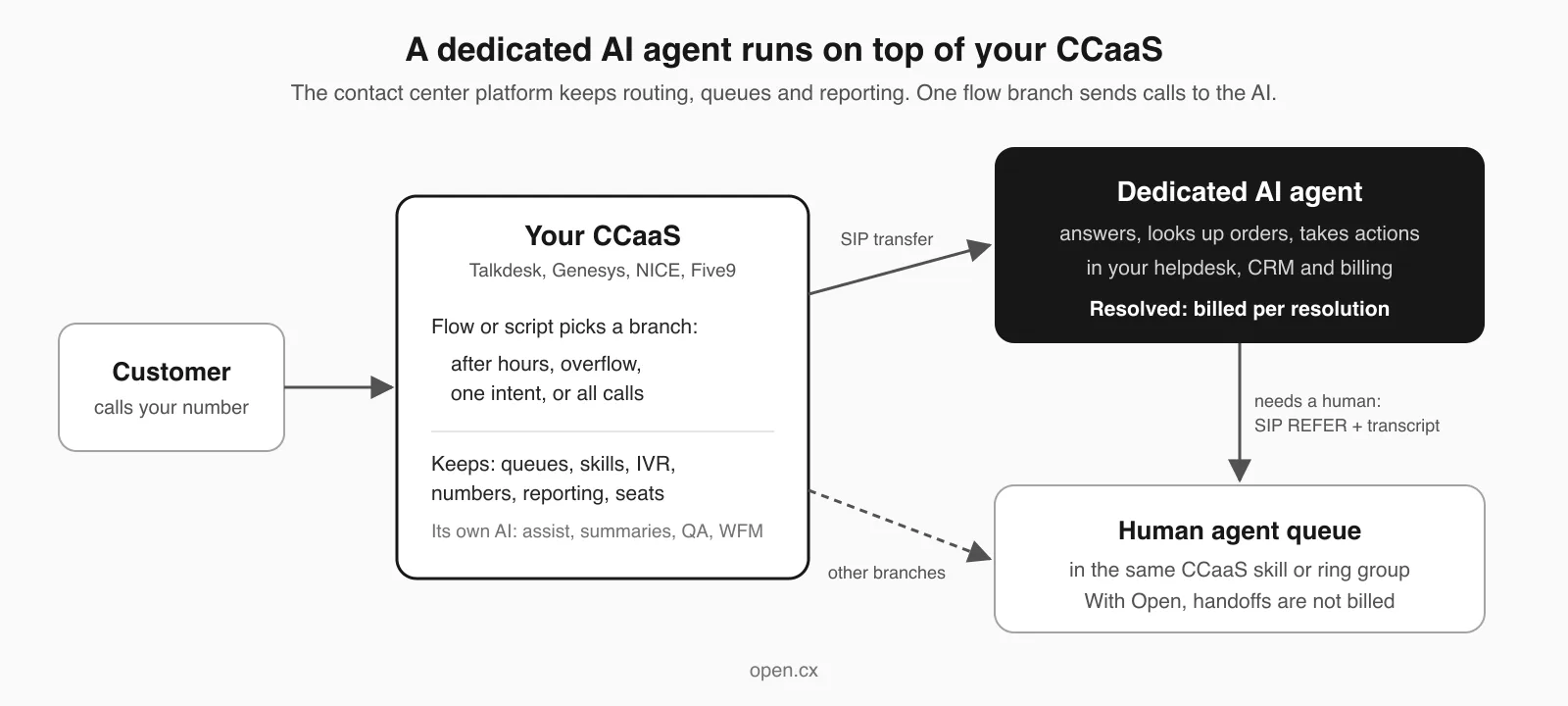
- A dedicated AI agent joins your CCaaS as a SIP destination. The CCaaS keeps routing, queues, human agents and reporting.
- The deciding question is what the AI is paid to do. To make human agents faster, use the platform's AI. To resolve conversations end to end, compare resolution rates and cost per resolution on real traffic.
- You don't need to migrate to test it. Route one flow branch (after hours, overflow, one intent) and measure for 30 days.
- Open runs on top of all four platforms and charges $0.75–$0.90 per resolution. Handoffs to a human aren't billed.
What is contact center AI?
Contact center AI is any AI used to handle or support customer conversations in a contact center. It falls into three groups:
- AI that talks to customers. AI agents and intelligent virtual agents (IVAs) answer calls, chats and messages, then resolve or route them.
- AI that helps human agents. Real-time transcription, suggested answers, knowledge lookups and after-call summaries.
- AI that helps managers. Interaction analytics, automated quality scoring, forecasting and scheduling.
CCaaS platforms cover all three. Dedicated AI agent vendors focus on the first, which is where most of the cost saving sits: every conversation an AI resolves is one a human doesn't handle. If you're looking at automation more broadly (routing, IVR, QA, WFM tools), see our guide to contact center automation software.
CCaaS AI: what each platform offers and what it costs
All four publish at least some seat prices. None publishes a per-conversation or per-resolution price for its customer-facing AI agents on its main pricing page.
| Platform | Published seat price (checked 15 Nov 2026) | Customer-facing AI | How that AI is priced |
|---|---|---|---|
| Talkdesk | $85 to $225 per user per month (Digital Essentials, Voice Essentials $105, Elite $165, Industry Experience Clouds $225) | Talkdesk Autopilot | Listed without a price. "For more add-ons and recommendations contact sales" |
| Genesys Cloud CX | $75 to $240 per user per month, billed annually (CX 1 $75, CX 2 $115, CX 3 $155, CX 4 $240) | Virtual agents and native bots on all plans | Metered in Genesys Cloud Experience Units. 250 named or 350 concurrent units per org per month included; CX 4 adds 30 named units per agent |
| NICE CXone | $110 to $249 per agent per month (Omnichannel Suite to Ultimate Suite) | AI agents for self-service, sales, proactive engagement and process automation | Listed under the Ultimate Suite at $249 per agent per month plus $0.25 per session. The page doesn't define a session |
| Five9 | Digital $119 and Core $159 per seat per month; Plus, Pro and Enterprise by quote. Per concurrent user, 50-seat minimum | Intelligent Virtual Agent and AI Agents | No published price. Bundled AI includes "3000 minutes per bundled seat + usage" |
Two usage-priced platforms work differently. Amazon Connect has no seat licences: it lists $0.038 per voice minute and $0.010 per chat message, with its AI features bundled into that channel price and telephony charged on top. Twilio Flex charges $150 per named user per month, $1 per active user hour, or $35 per monthly active user plus usage, and lists Agent Copilot (beta) at $0.035 per voice minute. Flex lists no virtual agent price, so customer-facing AI there usually comes from a partner. We compare those two in detail in Amazon Connect vs Twilio Flex.
Three things stand out in the table.
Seat pricing assumes humans. Every seat-priced model starts from agents or users. That works for AI that helps people. It fits less well for AI that replaces conversations, because the value of that AI grows as you need fewer seats.
AI agent pricing is the least transparent part. Talkdesk and Five9 send you to sales. Genesys meters it in its own units. NICE packages it into its top suite with a per-session fee. You may get a good price, but you won't know it until procurement.
The platforms expect outside AI. NICE lists "Bring your own virtual agent" in the AI section of its pricing page, marked as an add-on. All four can transfer a call to an external SIP destination from a flow. The CCaaS vendors already treat the AI agent as a layer that can come from elsewhere.
When the CCaaS's own AI is the better choice
A dedicated agent isn't always worth adding a vendor. Stay with the platform's AI when:
- You need agent assist and summaries. Copilots that sit in the agent desktop, transcribe in real time and write after-call notes are tied closely to the CCaaS. The platform's own version is usually the best integrated.
- You need quality and workforce management. Automated QA scoring, forecasting and scheduling depend on the CCaaS's data model and reports. Keep them there.
- You already pay for it. If your contract includes AI agents (a top-tier suite with self-service AI bundled, or Experience Units you aren't using), test them on real traffic before buying anything else.
- Procurement time is the constraint. One vendor, one DPA, one security review and one support line has real value, especially in regulated industries.
- Your intents are simple and scripted. For a deterministic flow such as "check balance" or "confirm appointment", a well-built platform IVA can be enough.
When a dedicated AI agent is the better choice
- You're measured on resolution, not deflection. A dedicated agent is judged on whether the customer's problem gets solved. That pushes the vendor to connect deeply to your helpdesk, CRM, order system and billing so the AI can take actions (refunds, rebookings, address changes), not only answer questions.
- You run more than one platform. Many companies have a CCaaS in one region, a PBX in another, and chat, email and WhatsApp in a helpdesk. A dedicated agent can sit on all of them with the same knowledge and behaviour.
- You want pricing tied to outcomes. Paying per resolution means you pay for conversations the AI closes, not for seats, sessions or consumption units.
- You want faster change. AI agent vendors ship model and behaviour updates on their own release cycle, which is usually faster than a CCaaS roadmap.
- You want to keep your options open. If the AI sits on top of the CCaaS, you can change contact center vendors later without rebuilding the AI, or change AI vendors without touching the contact center.
How a dedicated AI agent runs on top of your CCaaS
The mechanics are similar on all four platforms. The CCaaS stays the controlling system. The AI agent is added as an external SIP destination that a flow can transfer to, and calls come back the same way when a human is needed.
| Platform | Where you add the AI | How it hands back |
|---|---|---|
| Talkdesk | External Transfer step in a Studio Flow | SIP REFER to a ring group or skill, with transcript |
| Genesys Cloud CX | Transfer to External action in an Architect flow | SIP REFER to a queue, with transcript and intent |
| NICE CXone | SIP transfer action in a Studio script | SIP REFER to a skill, with transcript and intent |
| Five9 | External transfer in an IVR script or skill | SIP REFER to a skill, with transcript and intent |
This is how Open connects. You pick the branch: after self-service, on overflow, after hours, or on a specific intent. Your queues, skills, reports and numbers stay where they are, and you don't need extra CCaaS seats for the AI. Open's setup guides for Talkdesk, Genesys Cloud, NICE CXone and Five9 each put inbound setup at under 25 minutes. Amazon Connect and Twilio are covered too, and the full list of platforms and carriers is on the telephony page. For a Flex-specific walkthrough, see adding AI agents to Twilio Flex.
On cost, the CCaaS keeps invoicing seats and carrier minutes as before. Open charges $0.75–$0.90 per resolution, depending on volume. Conversations handed to a human aren't billed, and carrier and telephony costs are passed through at cost. See Open pricing.
A worked example (estimate)
Take a contact center with 100 agents handling 40,000 calls a month. Assume an AI agent resolves 35% of them end to end. Both numbers are assumptions for illustration, not benchmarks.
- Resolved by AI: 14,000 calls a month. On Open that's $10,500 to $12,600 a month at $0.75–$0.90 per resolution. The other 26,000 calls, including every handoff, cost nothing on the AI side.
- On a session-priced suite: at NICE's listed $0.25 per session, 40,000 AI sessions would be about $10,000 a month on top of $249 per agent seats, but only if every call counts as one session. NICE doesn't define a session on its pricing page, so ask.
- On a unit-metered plan: Genesys virtual agents draw down Experience Units. Without a published price per unit, you can't model this until you get a quote.
The point isn't which number is lower. It's that per-resolution pricing ties the bill to the work done, while session and unit pricing tie it to traffic. To run your own figures against human cost per call, see AI vs human call center cost.
How to compare: a 30-day test
Feature lists won't settle this. Real traffic will. A fair test looks like this:
- Pick one slice of traffic. After-hours calls, overflow from one queue, or one intent such as order status. Use the same slice for both options.
- Define "resolved" in writing. For example: no human touch, and no repeat contact on the same issue within 7 days. Apply the same rule to both.
- Measure four numbers. Resolution rate, CSAT on AI-handled conversations, handle time on calls that escalate, and total cost divided by resolved conversations.
- Check the handoff. Listen to 20 escalated calls. Did the human get the transcript and intent, or did the customer repeat themselves?
- Test your languages. If you serve Gulf Arabic, Dutch or French speakers, test with native speakers on real calls, not a demo script.
- Count the maintenance. Note who had to change prompts, flows or integrations during the 30 days, and how long it took.
Questions to ask any contact center AI vendor
- What exactly counts as a resolution, and do I pay for conversations handed to a human?
- Which systems can the AI take actions in, and which can it only read?
- Which languages and dialects work on voice today, not on the roadmap?
- Where is call audio and transcript data processed and stored, and for how long? Ask for documentation and check it against your own legal requirements. Open publishes its documentation at trust.open.cx.
- If we leave, what do we take with us: transcripts, knowledge, configuration?
- What happens to price as volume grows, and is it in writing?
The short version
Use your CCaaS's AI for the people in your contact center: assist, summaries, QA and workforce management. For the AI that talks to customers, run a test on real traffic and compare resolution rate and cost per resolution. If a dedicated agent wins, it runs on top of the platform you already have, so the decision doesn't need a migration.
Sources
- Talkdesk, "Pricing," https://www.talkdesk.com/pricing/, checked 15 Nov 2026
- Genesys, "Genesys Cloud CX pricing," https://www.genesys.com/pricing, checked 15 Nov 2026
- NICE, "CXone pricing," https://www.nice.com/pricing, checked 15 Nov 2026
- Five9, "Pricing," https://www.five9.com/pricing, checked 15 Nov 2026
- AWS, "Amazon Connect pricing," https://aws.amazon.com/connect/pricing/, checked 15 Nov 2026
- Twilio, "Flex pricing," https://www.twilio.com/en-us/flex/pricing, checked 15 Nov 2026
- Open, "Telephony integrations," https://www.open.cx/telephony, checked 15 Nov 2026
- Open, "Pricing," https://www.open.cx/pricing, checked 15 Nov 2026