
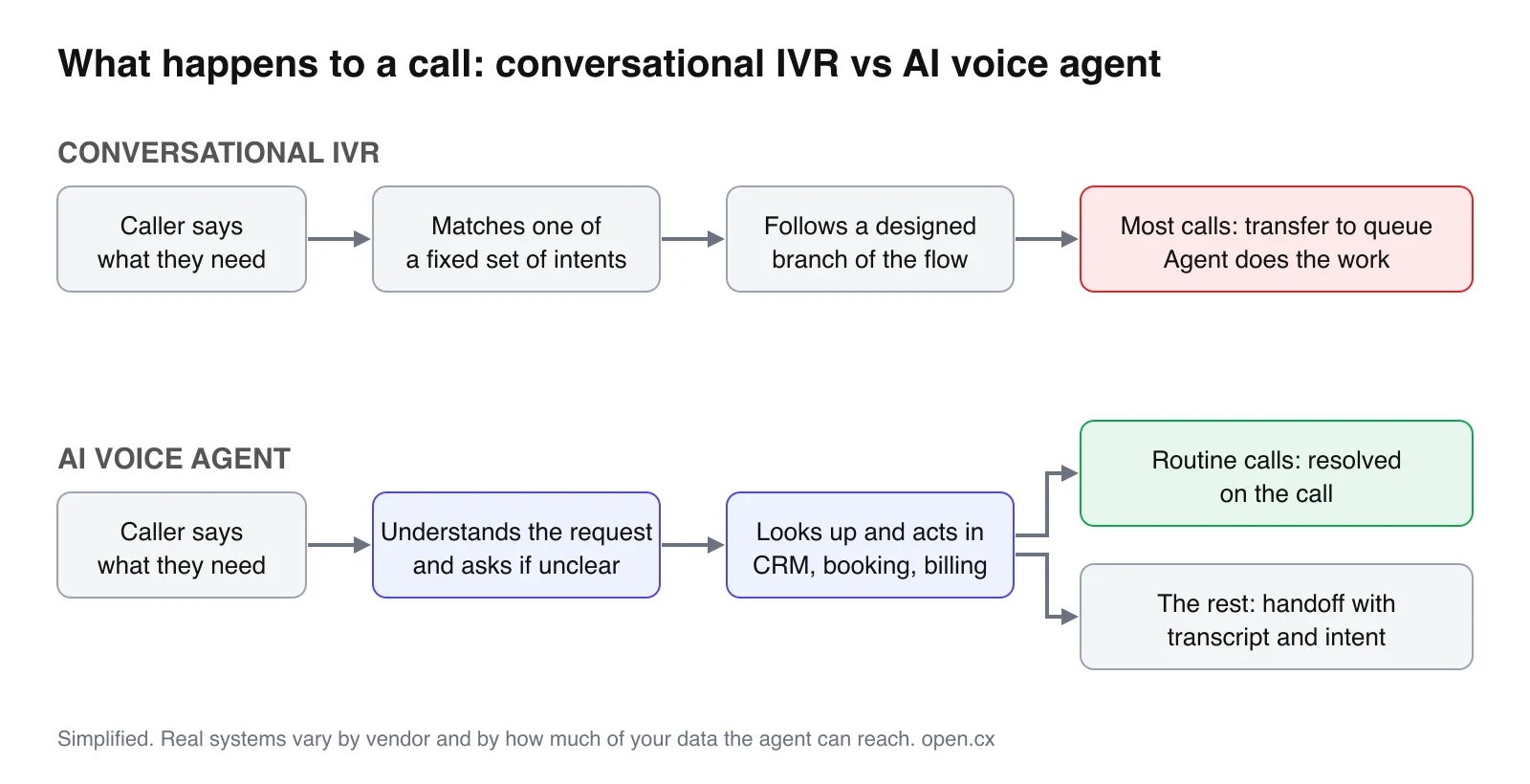
A conversational IVR lets callers speak instead of pressing keys, but it does the same job as the old menu: work out what the caller wants and send them to a queue. An AI voice agent holds a full conversation, looks things up in your systems and finishes the task, so many calls never reach a queue at all. If your goal is better routing, a conversational IVR is enough. If your goal is fewer calls for your agents to handle, you want an AI voice agent.
TL;DR
- Conversational IVR is speech-driven routing. It recognises intents ("billing", "change booking") and follows a flow someone designed. It rarely completes the task itself.
- An AI voice agent is built for resolution. It works from your knowledge and calls tools (CRM, booking, billing) during the call, then resolves the request or hands over with context.
- Test for task completion, not speech recognition. Ask "can this system finish the caller's request?" rather than "does it understand what people say?"
- The cost logic differs. IVRs are priced as infrastructure. AI agents are priced per minute or per resolution, so compare cost per resolved call.
- You don't need a big-bang switch. Put an AI agent behind one IVR branch or one number, compare results, then expand.
What is a conversational IVR?
A conversational IVR (also called natural language IVR or speech IVR) is an interactive voice response system that accepts spoken answers. Instead of "press 2 for billing", it asks "what are you calling about?" and maps the reply to one of a fixed set of intents using speech recognition and natural language understanding. The caller then moves down a designed path: a routing decision, a self-service step such as "say your account number", or a transfer.
Most contact centre platforms offer one. In Amazon Connect, for example, you build an Amazon Lex bot with intents and slots, then call it from a "Get customer input" block in a contact flow; each intent the bot recognises sends the caller down its own branch (AWS documentation, checked 15 Nov 2026). Genesys, Twilio and other CCaaS platforms have similar intent-bot builders.
The limits come from that design. Every intent, slot and branch is built by hand. When a caller says two things at once, changes their mind or asks something nobody mapped, the IVR re-prompts or transfers. It understands words better than a keypad menu does, but it still runs a tree.
What is an AI voice agent?
An AI voice agent is a phone agent built on a large language model, with speech-to-text and text-to-speech around it. It does not need every path designed in advance. It works from your knowledge base, your policies and a set of tools it is allowed to use, and it decides what to do turn by turn.
In practice it can:
- Handle open-ended requests ("my delivery didn't come and I'm away from Friday").
- Look up the order, booking or account in your systems during the call.
- Take the action: reschedule, rebook, send a payment link, update the ticket.
- Switch language when the caller does.
- Hand over to a person with a transcript and the detected intent when it should not go further.
The vocabulary is messy. Some vendors sell a conversational IVR with better speech recognition as an "AI IVR". In any demo, ask whether the system completes tasks or only directs calls. For a wider primer on the category, see our guide to AI voice agents for customer service.
Conversational IVR vs AI voice agent: side by side
| Conversational IVR | AI voice agent | |
|---|---|---|
| Core job | Classify and route | Resolve, then route what is left |
| How it is built | Designed intents, slots and flows | Instructions, knowledge, tool permissions |
| Off-script requests | Re-prompts or transfers | Asks a clarifying question, then works it out |
| Actions in your systems | Limited, pre-built steps (balance check, PIN) | Calls CRM, booking, billing and helpdesk tools live |
| Multi-intent calls | Usually one intent per turn | Several in one call |
| Languages | Often one flow per language | Detects and switches mid-call (varies by vendor) |
| Change effort | Edit flows, retrain intents | Update knowledge or instructions |
| Failure mode | Wrong queue, caller repeats themselves | Wrong answer if knowledge is poor; needs guardrails and review |
| Typical pricing | Platform fee plus per-minute infrastructure | Per minute or per resolution |
| Best for | Routing accuracy, simple self-service, strict scripts | Taking routine, high-volume calls off your agents |
Bottom line: a conversational IVR improves the front door. An AI voice agent takes work off the queue behind it.
When a conversational IVR is still the right choice
An AI voice agent is not the answer for every phone line. A conversational IVR, or even a touch-tone menu, may fit better when:
- The flow is fixed by regulation. Some identity and payment steps must follow an exact script, and a deterministic flow is easier to audit.
- Almost every call needs a specialist. If callers mostly need a human (claims assessment, complex sales), resolving calls in the IVR has little to gain. Better routing is the win.
- There is no data to act on. An agent that can't reach your order, account or booking systems can only answer FAQs.
- Volume is low. At a few hundred calls a month, the IVR you already own may be cheaper to keep.
Being honest about this saves a failed pilot. The AI voice projects that work start with call types that are frequent, routine and backed by data the agent can reach.
Where an AI voice agent wins
The case for moving past the IVR rests on calls it sends to people today even though no human judgement is needed:
- Status checks: where is my order, delivery, refund or claim.
- Changes: reschedule, rebook, cancel, update an address.
- Account tasks: resend an invoice, explain a charge, send a secure payment link.
- Policy questions: cancellation terms, opening hours, what is covered.
A conversational IVR can recognise all of these intents. It usually still transfers them. An AI voice agent with access to the right systems can finish them, and your human queue gets only the calls that need a person.
How much a well-built agent contains varies, and most published figures come from vendors. JustCall, which sells both, puts containment at 20 to 40% of calls for traditional IVR and 50 to 75% for AI voice agents (JustCall, checked 15 Nov 2026). Treat numbers like these as marketing estimates and measure your own. As a reference point from Open's customers, FareHarbor automates 87% of support across email, chat and voice for more than 23,000 tour, activity and attraction operators. That figure covers all three channels, not voice alone.
Cost: compare per resolved call, not per minute
IVR and AI agent pricing don't line up directly, so reduce both to one number: what you pay per call, including the calls that still need a human.
- Today: your monthly IVR and telephony cost, plus the fully loaded agent cost of every call the IVR transfers.
- With an AI agent: the agent's fee, plus carrier minutes, plus agent cost for the calls that still transfer.
- Compare the totals, not the line items.
Labour dominates. Gartner has said labour can make up as much as 95% of contact centre costs (Gartner, 31 Aug 2022, checked 15 Nov 2026). That's why resolution rate moves the total far more than the AI's per-minute price.
The pricing model matters too. Per-minute pricing charges for long and failed calls. Per-resolution pricing charges only when a call is resolved. Open charges $0.75 to $0.90 per resolution, depending on volume. Handoffs to a human are not billed, and carrier costs are passed through at cost, which the pricing page says typically comes in under $0.10 per resolution (checked 15 Nov 2026). For a fuller breakdown of how voice vendors price, see AI phone agent cost and pricing.
How to move from a conversational IVR to an AI voice agent
You don't have to rip out the IVR on day one. Most teams move in stages.
- Pull your IVR reports. List intents by volume and by transfer rate. High-volume, high-transfer, routine intents are your first targets.
- Check data access. For each target intent, confirm the agent can reach the system that answers it (order management, booking engine, CRM, billing).
- Put the agent behind one branch. Point a single IVR option, an overflow path or the after-hours route at the AI agent. Your platform keeps routing; the agent answers that leg.
- Keep your compliance prompts. Recording notices and required disclosures still play. In the EU, tell callers they are speaking to an AI: the AI Act's transparency duties under Article 50 have applied since 2 August 2026 (Goodwin, checked 15 Nov 2026).
- Run a controlled comparison. Send a share of traffic to the agent (about 10% for two weeks is a common start) and compare resolution rate, CSAT, repeat calls within seven days and handle time on escalations.
- Expand queue by queue. Move the next intent once the first is stable, and retire IVR branches as the agent takes them over.
- Read transcripts every week. Most gains after launch come from fixing the knowledge gaps that transcripts reveal.
On Genesys Cloud CX, step 3 is an External Transfer action in an Architect flow that sends the call to the AI agent's SIP address. Queues, skills, recording and reporting stay in Genesys, and when the agent needs a person it sends the call back to a Genesys queue with the transcript and intent attached (Genesys setup). Similar patterns exist for Amazon Connect, Twilio and Avaya. For the full setup on any platform, see how to set up an AI phone agent, and for designing the transfer itself, AI to human handoff.
What to ask vendors
| Question | Why it matters |
|---|---|
| Can it complete tasks in my systems during the call? | Separates an AI agent from a speech IVR |
| How does handoff work, and what does my agent see? | A transfer without transcript and intent repeats the IVR's worst habit |
| Can it sit behind my existing IVR and numbers? | Lets you migrate in stages |
| Which languages, and can it switch mid-call? | Common in Europe and the GCC |
| How is it priced when it fails to resolve? | Per-minute pricing bills failures; per-resolution doesn't |
| What do I see after each call? | Recordings, transcripts and outcomes are how you improve it |
| Where is call data processed and stored? | GDPR and procurement will ask |
Where Open fits
Open's AI voice agent answers calls through your existing phone system and carrier, uses your helpdesk, CRM and knowledge, and hands to a person with the live transcript, intent and customer context attached. It handles 100+ languages and can switch mid-call. The replace IVR with AI page covers the migration: start on one number or branch, keep your routing rules and compliance prompts, and expand queue by queue. For Open's security documentation, see trust.open.cx.
If you are still choosing between the two, run your top three transferred IVR intents through an AI agent. Within a couple of weeks you'll know whether your gain is in routing or in resolution.
Sources
- AWS, "Add an Amazon Lex bot to Amazon Connect," https://docs.aws.amazon.com/connect/latest/adminguide/amazon-lex.html, checked 2026-11-15
- JustCall, "AI agents vs IVR in customer service" (vendor estimate), https://justcall.io/blog/ai-agents-vs-ivr-customer-service.html, checked 2026-11-15
- Gartner, "Gartner Predicts Conversational AI Will Reduce Contact Center Agent Labor Costs by $80 Billion in 2026" (31 August 2022), https://www.gartner.com/en/newsroom/press-releases/2022-08-31-gartner-predicts-conversational-ai-will-reduce-contac, checked 2026-11-15
- Goodwin, "Not Delayed, Not Deferred: EU AI Act Transparency Obligations Are Now in Force" (3 August 2026), https://www.goodwinlaw.com/en/insights/publications/2026/08/alerts-technology-dpc-eu-ai-act-transparency-obligations-now-in-force, checked 2026-11-15
- Open, "Replace IVR with AI," https://www.open.cx/voice/replace-ivr-with-ai, checked 2026-11-15
- Open, "Genesys Cloud CX AI phone agent," https://www.open.cx/telephony/genesys, checked 2026-11-15
- Open, "FareHarbor customer story," https://www.open.cx/customer-stories/fareharbor, checked 2026-11-15
- Open, "Pricing," https://www.open.cx/pricing, checked 2026-11-15