
Ada doesn't publish prices. Its pricing page leads to a demo booking, and every contract is quoted. Third-party procurement data from Vendr puts the median Ada contract at about $75,000 a year, with a range of roughly $36,000 to $277,000. Most customers are reported to pay per conversation, with per-resolution pricing offered to some enterprise accounts.
Those are estimates, not Ada's numbers. This guide explains how Ada's pricing works, what the public data suggests you'll pay, when the cost pays off, and what to ask in procurement so the quote you get matches the bill you receive.
TL;DR
- No public price list. Ada's pricing page asks you to book a demo. All figures here are third-party estimates, checked 15 November 2026.
- Median contract around $75,000 a year (Vendr), range about $36,478 to $277,000.
- Billing is mostly per conversation. Ada's own blog argues conversation-based pricing suits most enterprises and uses $0.35 per conversation and $1.50 per resolution as illustrative figures.
- Watch the extras. Vendr estimates implementation at $15,000 to $100,000+ and overage at $0.20 to $0.50 per conversation above contracted volume at standard rates ($0.05 to $0.15 when negotiated).
- Per-conversation pays off only if your resolution rate is high. At $0.35 per conversation, you pay more per resolved ticket than a $0.90 per-resolution price whenever fewer than about 39% of conversations get resolved.
Does Ada publish its pricing?
No. Ada's pricing page offers a 30-minute custom demo that includes a business case and "an ROI model grounded in your volume." There are no plans, tiers or rates on the page. Vendr's Ada listing says the same: pricing isn't published and quotes are customized.
That isn't unusual for enterprise AI agents. Decagon and Sierra don't publish prices either (see the side-by-side AI agent pricing table). Fin, Zendesk and Salesforce do. The cost of opacity is that you can't compare Ada to the field until you're inside a sales cycle, so it helps to arrive with a benchmark.
How Ada's pricing works
Conversation-based pricing
Third-party reviews that cite Ada's documentation say most Ada customers buy on a per-conversation basis: you pay for each conversation the AI agent handles, whether it resolves the issue or hands it to a person. Ada's blog post on the topic sums up the model as "A conversation is a conversation."
The upside is predictability. Your bill tracks traffic, not performance, so it doesn't rise as the agent gets better. The downside is that you pay for conversations the agent didn't solve, including every one that ends with a human.
Resolution-based pricing
Ada also offers resolution-based pricing to some enterprise customers. Here you pay only when the agent resolves the conversation without escalation, at a higher unit price. Ada argues against this model on its blog, on the grounds that your bill grows as automation improves.
Ada's own example numbers
Ada's pricing explainer models a scenario with 500,000 conversations in year one, 10% annual growth, and a resolution rate rising from 25% to 75% over three years. It uses $0.35 per conversation and $1.50 per resolution to compare the two models. These are hypothetical figures in a blog post, not a published rate card, but they're the only numbers Ada itself has put in public.
What Ada costs: third-party estimates
| Cost item | Estimate | Source |
|---|---|---|
| Median annual contract | $75,000 | Vendr |
| Contract range | $36,478 to $277,000 per year | Vendr |
| Average negotiated saving | ~17% | Vendr |
| Annual price escalator | ~3% to 7% | Vendr |
| Entry-level first-year cost (platform plus implementation) | ~$30,000 to $60,000 | Vendr |
| Mid-tier annual platform fee | ~$60,000 to $150,000 | Vendr |
| Enterprise annual platform fee | ~$150,000 to $300,000+ | Vendr |
| Implementation | ~$15,000 to $100,000+ | Vendr |
| Overage above contracted volume | ~$0.20 to $0.50 per conversation at standard rates, ~$0.05 to $0.15 negotiated | Vendr |
| Per resolution (where offered) | ~$1.00 to $3.50 | Featurebase, "reported" figures (competitor-authored) |
| Starting price | ~$30,000 per year | Salesforce AppExchange listing, via Featurebase |
Treat every row as an estimate, and note that Vendr's own page gives conflicting purchase counts, so read the median as indicative. The useful takeaway is the shape: a platform fee in the tens of thousands, implementation on top, and per-conversation overage once you pass your committed volume.
When Ada pays off
The question isn't whether $75,000 is a lot. It's what you pay per ticket the agent resolves, compared with what a human-handled ticket costs you today.
The resolution-rate break-even
On per-conversation pricing, your effective cost per resolution is the per-conversation price divided by your resolution rate. Using Ada's illustrative $0.35:
| Resolution rate | Effective cost per resolved conversation |
|---|---|
| 25% | $1.40 |
| 40% | $0.88 |
| 50% | $0.70 |
| 60% | $0.58 |
| 75% | $0.47 |
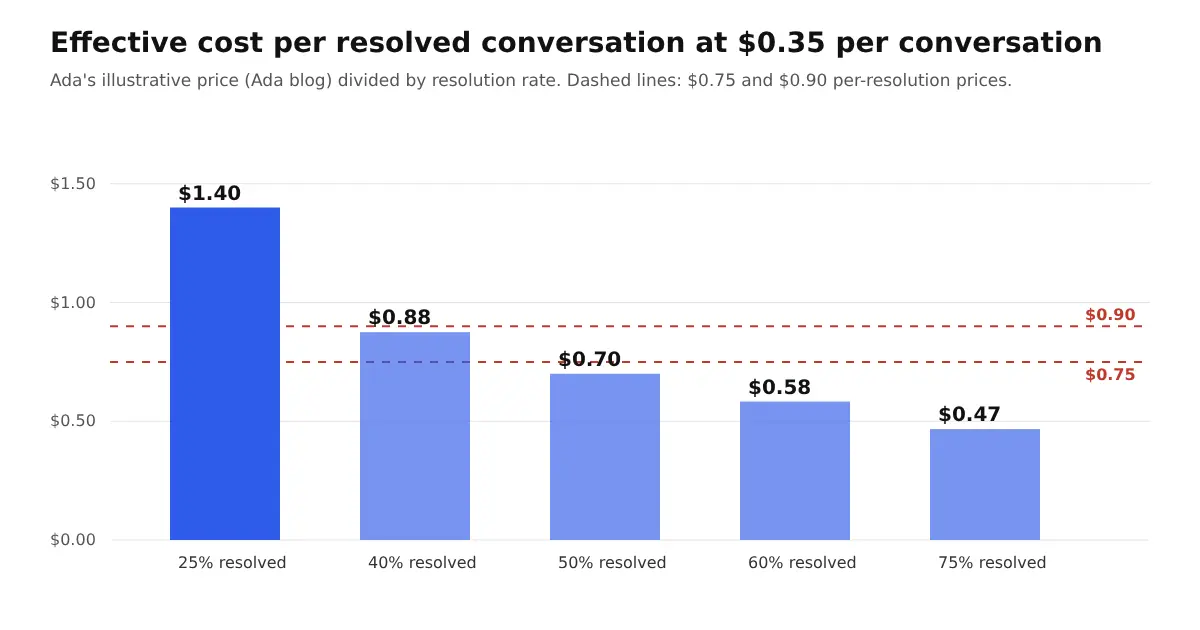
So a $0.35 per-conversation price beats a $0.90 per-resolution price once more than about 39% of conversations are resolved, and beats $0.75 once more than about 47% are. Below those rates, per-resolution pricing is cheaper. Early in a deployment, when the agent still escalates a lot, per-conversation pricing tends to cost more than it looks.
A worked example
Say you handle 20,000 conversations a month and a human-handled ticket costs you $5 all in (use your own number).
- At $0.35 per conversation, Ada's usage cost is $7,000 a month before platform fees.
- At a 30% resolution rate, the agent resolves 6,000 tickets. You save $30,000 in human cost for $7,000 in AI cost, an effective $1.17 per resolution.
- At a 60% resolution rate, it resolves 12,000. You save $60,000 for the same $7,000, about $0.58 per resolution.
Both scenarios pay off at a $5 human cost. The difference is how fast, and how much the platform fee and implementation eat into year one. Plug your real volumes and costs into the ROI calculator before the sales call so you can test any quote in minutes.
What to ask Ada in procurement
Ada's quote will be custom, so the terms matter more than the headline number. Ask for these in writing:
- What counts as a billable conversation? Does a customer who opens the widget and leaves count? Does a proactive message count only if the customer replies?
- Which pricing model are we on, and can we switch? If you start per conversation, can you move to per resolution once your resolution rate is stable?
- How is a resolution defined if we choose resolution-based pricing? Who decides, and can we audit it?
- What's included in the platform fee? Channels, languages, voice, number of integrations, sandbox environments.
- What does implementation cost, and who does the work? Get a fixed scope and price, not an estimate.
- How is voice priced? Per conversation, per minute, or separately? Are carrier costs marked up?
- What's the overage rate, and what happens to unused committed volume at year end?
- What's the annual escalator and the renewal notice period?
- What discount applies to a multi-year term, and what are the exit terms if the resolution rate misses target?
Ada alternatives with published pricing
If you want to benchmark Ada against public numbers, three vendors publish theirs. Fin charges $0.99 per outcome. Zendesk charges $1.50 per automated resolution on a committed plan and $2.00 pay-as-you-go. Salesforce Agentforce lists $2 per conversation.
Open publishes $0.75 to $0.90 per resolution, depending on volume, on its pricing page. Handoffs to a human aren't billed, so you never pay for a conversation the agent didn't solve. Agent 5 runs one agent across chat, email, WhatsApp, social, Slack and voice, and carrier costs are passed through at cost. For a sense of results, TicketSwap reports a 78% automation rate.
For a wider set of options, read the Ada review and alternatives and how AI customer service pricing works. To see how Ada's closest rivals bill, see Decagon vs Sierra vs Fin.
Where Ada can be the better fit: if your resolution rate is already high and stable, a well-negotiated per-conversation rate can come in below any per-resolution price, and you get a bill that doesn't grow as the agent improves.
Sources
- Ada, "Pricing," https://www.ada.cx/pricing, checked 2026-11-15
- Ada, "Unpacking AI agent pricing: resolution-based vs conversation-based models," https://ada.cx/blog/unpacking-ai-agent-pricing-resolution-based-vs-conversation-based-models/, checked 2026-11-15
- Vendr, "Ada" marketplace listing, https://www.vendr.com/marketplace/ada, checked 2026-11-15
- Featurebase, "Ada.CX Pricing 2026" (competitor-authored), https://www.featurebase.app/blog/ada-cx-pricing, checked 2026-11-15
- Chatbase, "Ada CX pricing: What does it cost in 2026?" (reports Ada's conversation-based default), https://www.chatbase.co/blog/ada-cx-pricing, checked 2026-11-15
- Fin, "Pricing," https://fin.ai/pricing, checked 2026-11-15
- Zendesk, "Pricing," https://www.zendesk.com/pricing/, checked 2026-11-15
- Salesforce, "Agentforce pricing," https://www.salesforce.com/agentforce/pricing/, checked 2026-11-15
- Open, "Pricing," https://www.open.cx/pricing, checked 2026-11-15
- Open, "TicketSwap customer story," https://www.open.cx/customer-stories/ticketswap, checked 2026-11-15